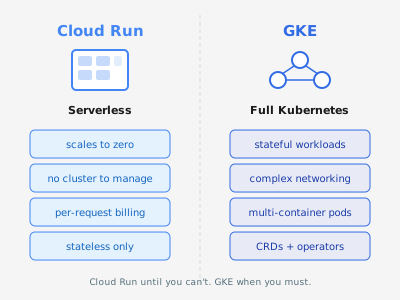
Both run containers. The question is how much of the infrastructure you want to own.
Estimated Reading Time : 8m
What Cloud Run is
Cloud Run is a fully managed compute platform on GCP that runs stateless containers. You push a container image, Cloud Run handles scaling, networking, TLS, and infrastructure.
Key characteristics:
- Scales to zero — no traffic, no cost
- Scales up automatically based on request volume
- Per-request billing (CPU and memory charged only while handling a request)
- No cluster to manage
- Deploys in seconds
A typical Cloud Run service is an HTTP or gRPC API behind a managed load balancer. You configure CPU, memory, concurrency, and max instances — Cloud Run handles the rest.
gcloud run deploy my-api \
  --image gcr.io/my-project/my-api:latest \
  --region us-central1 \
  --allow-unauthenticated \
  --cpu 1 \
  --memory 512Mi \
  --max-instances 10
What GKE is
Google Kubernetes Engine is a managed Kubernetes service. You get a full Kubernetes cluster — nodes, networking, RBAC, namespaces, custom controllers, the entire API surface.
GKE manages the control plane. You manage the workloads, configurations, and (in Standard mode) the node pools.
gcloud container clusters create my-cluster \
  --region us-central1 \
  --num-nodes 3 \
  --machine-type e2-standard-4
Where Cloud Run wins
Stateless HTTP/gRPC services. If your workload receives a request, processes it, and returns a response, Cloud Run is purpose-built for this. No Kubernetes manifests, no cluster maintenance, no node sizing.
Variable traffic patterns. A service that gets 1000 requests per minute during the day and zero at night benefits directly from scale-to-zero. On GKE, those idle nodes still cost money.
Fast iteration. Deploying to Cloud Run is a single command. No rollout strategy to configure, no pod disruption budgets, no readiness probe tuning. When you’re moving fast and the workload is simple, this matters.
Cost at low-to-medium scale. For services that don’t run 24/7 or handle moderate traffic, Cloud Run’s per-request pricing is significantly cheaper than maintaining a GKE cluster.
Where GKE wins
Stateful workloads. Databases, caches, message brokers, or anything that needs persistent volumes and stable network identities. Cloud Run is stateless by design — there’s no persistent disk, no StatefulSet equivalent.
Complex networking. If you need service meshes, network policies, custom ingress controllers, or VPC-native pod networking with fine-grained control, GKE gives you the full Kubernetes networking model.
Multi-container pods. Sidecar patterns — log collectors, proxy containers, init containers — require Kubernetes pod semantics that Cloud Run doesn’t support.
Long-running background work. Cloud Run has a request timeout (up to 60 minutes). For workloads that run continuously — stream processors, queue consumers, scheduled batch jobs — GKE is the better fit.
Custom controllers and CRDs. If your infrastructure relies on operators, admission webhooks, or custom resource definitions, you need a Kubernetes API server. Cloud Run doesn’t have one.
GKE Autopilot
GKE Autopilot is the middle ground. You get a full Kubernetes API, but Google manages the nodes. You pay per pod (based on requested resources), not per node.
Autopilot makes sense when you need Kubernetes features but don’t want to manage node pools, auto-scaling groups, or OS patching. The tradeoff is less control over node configuration — no DaemonSets, no privileged containers, no SSH to nodes.
The decision framework
Start with Cloud Run. If you hit a wall — stateful requirements, networking complexity, multi-container pods, or features that require the Kubernetes API — move to GKE.
The common mistake is starting with GKE because it’s more “complete.” A GKE cluster has operational overhead from day one: node upgrades, cluster maintenance windows, RBAC configuration, resource quotas. If your workload is a stateless API, you’re paying for complexity you don’t need.
Cloud Run until you can’t. GKE when you must.